

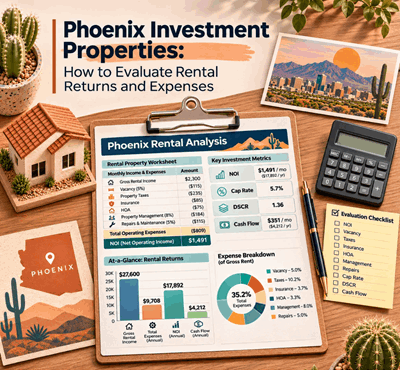
 Phoenix Investment Properties: How to Evaluate Rental Returns and Expenses
· By Inna Novey, The Novey Team at West USA Realty
Quick answer: To evaluate a Phoenix investment property, subtract vacancy and every operating expense from rent to get net operating income (NOI), then check cap rate, cash flow, cash-on-cash return and DSCR. In 2026, plan for flat rents, 5%–8% vacancy, rental-class property taxes and higher insurance.
Many Phoenix investors buy because the rent looks close to the mortgage payment. That test misses most of the real costs. In late 2026, a typical Phoenix single-family rental bought with 25% down at investment-loan rates loses money each month before appreciation. The deals that work are the ones where the buyer ran honest numbers first. Here is how to run them.
Phoenix Rental Market in 2026
Phoenix rents are flat, and vacancy is slowly improving after a record apartment building wave. Underwrite today's rent, not hoped-for growth.
- Average rent: about $1,843/month in November 2026, flat for a year (Trulia).
- Vacancy: 6.5% for stabilized metro apartments in Q3 2026 (Northmarq).
- Demand: 12,741 apartment units absorbed in the first half of 2026, the strongest six months since at least 2000 (Cushman & Wakefield).
- Rates: 30-year mortgages averaged about 7.26% in early November, and investment loans usually price 0.5%–1% higher (Bankrate).
Single-family homes in good school areas are holding up better than apartments, which compete with new supply and move-in specials. Rents also vary a lot between Downtown Phoenix, Scottsdale, the West Valley and the Southeast Valley, so always pull leased comps from ARMLS for the exact neighborhood.
The Numbers That Measure Rental Returns
|
Metric |
Formula |
Phoenix guideline |
|---|---|---|
|
Gross yield |
Annual rent ÷ price |
Most homes 5%–7% |
|
NOI |
Collected rent − operating expenses |
Expenses often 40%–50% of rent |
|
Cap rate |
NOI ÷ price |
Single-family often 3%–5% |
|
Cash flow |
NOI − mortgage payments |
Positive after reserves |
|
Cash-on-cash |
Cash flow ÷ cash invested |
Many target 6%+ |
|
DSCR |
NOI ÷ annual debt service |
Lenders want 1.0–1.25+ |
NOI leaves out your mortgage. Cap rate lets you compare a Mesa duplex with a Glendale house on equal terms. DSCR is what DSCR lenders use to qualify you on the property's rent instead of your income. Your full return also includes loan paydown, appreciation and tax benefits, so talk to a CPA.
The 1% rule (monthly rent = 1% of price) almost never works in Phoenix in 2026. Use it to sort listings, not to decide.
Phoenix Rental Expenses to Budget
- Property tax: A rental is Class 4 with the Maricopa County Assessor and does not get owner-occupied treatment, so your bill may be higher than the seller's. Arizona also requires you to register the rental with the Assessor.
- Insurance: Phoenix homeowners premiums average roughly $2,400–$2,800 a year (ValuePenguin). Landlord policies often cost more, and roof age matters.
- HOA: Many Valley communities have dues, and some limit rentals or lease length. Read the CC&Rs first.
- Vacancy: Budget 5%–8% of rent. Summer move-ins are slower.
- Management: About 8%–10% of rent, plus a leasing fee.
- Repairs and reserves: At least 5% for repairs and 5%–10% for HVAC, roof and water heaters. Air conditioning works hard in 110°F summers.
- Rental tax: $0 on long-term leases. Cities could no longer tax residential rent as of January 1, 2025 (ADRE). Phoenix had charged 2.3%.
Worked Example: A $425,000 Phoenix Rental
Assumptions: 3-bed home, $2,150 rent, 25% down, 7.75% investment loan, 3% closing costs, tenant pays utilities. Figures are illustrative.
|
Line |
Annual |
|---|---|
|
Gross rent |
$25,800 |
|
Vacancy (6%) |
−$1,548 |
|
Property tax (estimate) |
−$2,900 |
|
Insurance |
−$2,600 |
|
HOA |
−$1,200 |
|
Management (8%) + leasing fee |
−$3,015 |
|
Repairs (5%) + reserves (5%) |
−$2,580 |
|
Net operating income |
$11,957 |
|
Mortgage payments |
−$27,403 |
|
Cash flow |
−$15,446 |
That is a 2.8% cap rate, −13% cash-on-cash and a 0.44 DSCR. Rent would need to be about $3,930 to break even. At $2,150 rent, a 5.5% cap rate needs a price near $217,000. The lesson is not "don't buy." It is "buy the right property at the right price."
Long-Term vs. Short-Term Rentals
Long-term leases now carry no city rental tax and little paperwork. Short-term rentals can earn more, but they need a $250 City of Phoenix permit renewed yearly, an Arizona TPT license, $500,000 in liability coverage, and about 12.6% in combined lodging taxes (City of Phoenix). Many HOAs ban stays under 30 days, and summer bookings drop sharply.
Where the Numbers Work
- Small multifamily (2–4 units) in central Phoenix, Mesa, Tempe or Glendale
- Value-add homes bought below market
- Lower price points in parts of the West Valley
- Builder rate buydowns in Buckeye, Goodyear and Queen Creek
- House hacking with an owner-occupant loan
Common mistakes include using the seller's tax bill, skipping CapEx, assuming zero vacancy, trusting a Zestimate for rent, and not reading the HOA documents.
Phoenix Rental Property FAQs
Is Phoenix a good place to buy a rental in 2026? It can be a good long-term market, but most financed single-family homes do not cash flow at current prices and rates. Buy on today's rent.
What is a good cap rate in Phoenix? For single-family rentals, 4%–5% is solid in 2026. At 3% or lower, you are relying on appreciation.
Do Arizona landlords still charge rental tax? No, not on long-term residential leases since January 1, 2025. Short-term rentals still pay lodging taxes.
Do I need a license to rent my Phoenix home? Long-term rentals must be registered with the county assessor. Short-term rentals also need a city permit and a state TPT license.
What vacancy rate should I use? Use 5%–8% of gross rent.
How much do Phoenix property managers charge? Usually 8%–10% of rent, plus a leasing fee of half to a full month's rent.
How are rental properties taxed in Maricopa County? Rentals are classified as Class 4 and do not receive the primary-residence treatment, so the bill is usually higher than an owner-occupant's. Confirm it on the Maricopa County Assessor and Treasurer sites.
Is a DSCR loan good for a Phoenix rental? It can be if the rent covers the payment. Most DSCR lenders want a ratio of about 1.0–1.25 or higher, and rates run above conventional loans.
Which Phoenix-area cities are best for rental investors? It depends on your goal. Central Phoenix, Mesa and Tempe suit small multifamily. Goodyear, Buckeye and Surprise offer lower prices and builder incentives. Gilbert and Queen Creek attract families who stay longer.
Get a Free Rental Analysis
Thinking about a Phoenix-area investment property? Send it to The Novey Team at West USA Realty. Call Inna Novey at 602-672-7012. Unlock Your Dreams!
Categories
Recent Posts





GET MORE INFORMATION